Abstract
There is a requirement within global biodiversity policy that conservation awareness is promoted and there is mixed evidence regarding the effectiveness of raising awareness. This article looks at how Asian Adventures ; an ecotourism business offering bird watching and wildlife tours has raised awareness of conservation. They were set up in 1994 with the motto ‘Tourism for Conservation – Conservation for Tourism’. Specialist birding tours are offered, the Jungle Lore Birding Lodge which includes a waste management initiative in a local village (Pangot), the Gir Birding Lodge which runs the Pangolin Project. Interpreters include naturalists and short guided walks known as Earth Walks. These have been analyses by looking at the criteria from the Global Sustainable Tourism Council, ecotourism features from UN Tourism, tourism guidelines from the Convention on Biological Diversity and the communication, education and awareness programme. From public sources it was clear that there is a cohesive approach to creating awareness with specific people identified as delivering the awareness. However, little information was available on how effective the awareness was in terms of reach, attitudes and behaviour. Key focus will be on addressing this.
01Introduction: Understanding Ecotourism and Conservation Awareness
1.1 Ecotourism and the sustainable tourism frameworks
Ecotourism is a segment of sustainable tourism in which the quality of the natural setting is the product. Three reference frameworks give the term operational meaning.
UN Tourism. Ecotourism can be described as a form of nature-based tourism where tourists’ primary motivation is to observe and appreciate nature and traditional cultures in natural areas. It should also have an educational and interpretive aspect and support the conservation of natural areas used as an attraction (A1). This fits into a sustainable tourism concept that was defined by UNEP and the World Tourism Organization in 2005 as tourism which 'fully considers the present and future economic, social and environmental impacts of tourism and addresses the concerns of visitors, the industry, the environment and host communities’ (A2).
Global Sustainable Tourism Council (GSTC). The GSTC criteria are the most commonly used benchmark for assessing sustainability within the tourism industry. The criteria are divided into 4 pillars (sustainable management, sociology-economic impacts, cultural impacts and environmental impacts) that are designed to be a minimum standard that can be tailored to local situations. There are separate criteria for destinations and the tourism industry (tour operators etc.), which Asian Adventures fall into [A3].
Convention on Biological Diversity (CBD). The CBD guidelines have been drawn up as a ‘best practice’ initiative for all types of tourism and are designed to foster a symbiotic relationship between tourism and biodiversity through engaging the private sector and local communities, allocating some of the tourism income to conservation and increasing public education and awareness [A4]. The International Ecotourism Society (TIES) states that ecotourism is ‘responsible travel to natural destinations which conserves the environment and improves the well-being of local people’ [A5].
1.2 Conservation awareness and its policy frameworks
Awareness of conservation can be described as knowledge, feelings and actions people are willing to take in order to conserve species and habitats. This is a more specific term than nature education, which covers general learning. There are three key policies to consider.
- CBD Communication, Education and Public Awareness (CEPA). CEPA is grounded in Article 13 of the Convention, on public education and awareness, and is guided by the Kunming-Montreal Global Biodiversity Framework. Its stated purpose is to ensure that knowledge about biodiversity reaches all sectors of society [A6].
- Kunming-Montreal Global Biodiversity Framework, Target 21. The target calls for the best available data, information and knowledge to be accessible to decision-makers and the public, and includes strengthening communication, awareness-raising and education [A7].
- Sustainable Development Goal Target 4.7. By 2030 all learners should acquire the knowledge and skills needed to promote sustainable development, including through education for sustainable development and sustainable lifestyles [A8].
Awareness is also an operational requirement for tour operators. The GSTC criteria expect businesses to inform and engage visitors about natural and cultural values and appropriate behaviour [A3], and UN Tourism’s ecotourism characteristics include interpretation [A1].
1.3 Scope and method
This article takes one Indian operator, Asian Adventures, as a case. Founded in 1994 by Mohit Aggarwal and based in Noida, it runs bird watching and wildlife tours, operates its own eco-lodges and, through Earth Walks, extends its work to city residents [B1][B5]. The review is document-based. It draws on the organization's website and published policy, public event listings, press and United Nations reports and the research literature. The organization's own pages were read in October 2026 and could not all be re-read when this article was finalized on 10 November 2026. The study involved no site visits, interviews or access to internal data. Claims that originate with the organization and could not be confirmed independently are labeled “self-reported.” Where public sources are silent, the article says so rather than inferring.
02The Role of Conservation Awareness in Conservation
There are four ways that awareness will help conservation. These have been matched to the requirements of the frameworks above. It should be seen as a benchmark rather than an automatic benefit, as the research shows that awareness doesn’t directly lead to action.
2.1 Biodiversity awareness and education: the awareness-to-action gap
The central difficulty in awareness work is that knowing is not doing. Kollmuss and Agyeman’s widely cited review, “Mind the Gap,” examines why people who hold pro-environmental views often do not act on them, and argues that behaviour is shaped by many interacting factors rather than by knowledge alone [C2]. Three bodies of evidence are relevant here.
- Direct experience. Soga and Gaston’s meta-analysis finds that direct experience of nature is positively associated with pro-environmental actions such as recycling, energy conservation, green purchasing and conservation volunteering. The link to wildlife and habitat actions is stronger but only marginally significant. The association was similar for childhood and later-life experience, and the authors call for experimental or longitudinal studies to test cause and effect [C3]. The finding is an association, not proof that a walk changes behaviour, and it supports programmed aimed at adults as well as children.
- Animal imagery. A scoping review by Thomas-Walters, McNulty and Veríssimo found that animal imagery can improve attitudes and willingness to protect, but that evidence is scarce, few studies measured actual behaviour, and social-media engagement is an unreliable stand-in for it [C4]. Striking images attract attention; they are not shown to produce action.
- Participation. Tasks that give people something specific to do, such as counting, recording or reducing waste, link awareness to a concrete act. This is a design principle rather than a research finding in the sources reviewed, and it is the reasoning behind several Asian Adventures activities discussed below.
Birds suit this purpose because they are visible, diverse, active at predictable hours and found from city wetlands to Himalayan forest. Asian Adventures argues, in its own materials, that people protect what they have first come to value [B2].
2.2 Local community support
CBD guidelines require ecotourism to provide revenues and jobs for the local community with inclusion in planning (A4). This is important for raising awareness in two ways. If the community are receiving income for their wildlife they will have an incentive to look after it. Local people who are trustworthy such as a village guide, or someone from the lodge can be more effective at delivering messages. In reference to the GSTC sociology-economic pillar businesses should ensure the local community are providing education and making decisions (A3).
2.3 Responsible wildlife interaction as a form of communication
Visitors should also consider how they act around wildlife. Following trail rules such as keeping your distance, keeping quiet and not offering food or bait, guides can explain how to act around wildlife. Asian Adventures’ sustainability policy states they will not do sporting activities like hunting and sport fishing. They also will not encourage attractions involving captive animals. Each site will have guides that are certified and usually local [B2]. Earth Walks have listed aspects of their learning including ethical bird watching and keeping silent. They will not encourage flash photography, and alcohol and illegal substances are prohibited [B6].
2.4 Long-term environmental footprint
An awareness campaign that does not change what people do afterwards has a footprint but no conservation return. The CBD guidelines expect monitoring and adaptive management of tourism’s effects [A4]. Travel to a site is usually the largest single component of a trip’s emissions, so on-site measures such as plastic bans, though valuable, do not make a long-haul trip low-impact. Short walks in participants’ home cities, as Earth Walks offers, avoid most of that cost, which is an argument for local programmes alongside destination tourism.
03How Asian Adventures Contributes to Conservation Awareness
Asian Adventures presents “Tourism for Conservation – Conservation for Tourism” as an operating model in which tourism revenue and conservation action support each other [B1]. It describes itself as India’s largest birding ground handler [B5], states that it is at the first stage (“Engaged”) of the three-stage Travelife certification programme [B1], and publishes a sustainability policy covering purchasing, waste, energy, transport, staff training, suppliers and activities [B2]. Table 1, at the end of the section, summaries the awareness channels and how strong the public evidence is for each.
3.1 Promoting bird watching and low-impact wildlife tours
Bird watching is the organization's core product, offered through species-specific, regional and photography itineraries across India, for example a 15-day Gujarat tour combining Gir National Park and the Little Rann of Kutch scheduled for November 2026 [B5]. It is non-consumptive, can be done in small groups on foot or by quiet vehicle, and is concentrated in the early morning and late afternoon. On a tour, awareness is delivered in the field: the guide names the species, explains the habitat and, where relevant, the threat.
Guests are asked to carry biodegradable or cloth bags for waste produced in the field, and single-use plastic is banned at the organization's stays [B1]. The organization's guides take part in monitoring of waders (shorebirds) with the group WaderQuest, recording numbers and the condition of wetland habitat during tours [B1]; no outputs were found in the sources reviewed (self-reported). On tours sold through the partner brand Bubo Birding, for which Asian Adventures provides logistics, 1% of the tour cost goes to a conservation fund supporting local projects [B7]. Guests are therefore asked to do something specific, carry out waste and contribute to a fund, as well as to listen.
3.2 Eco-lodges and sustainable destination operations: Pangot and Gir
Jungle Lore Birding Lodge, Pangot (Uttarakhand). Pangot is a hill village about 15 to 17 km from Nainital at roughly 2,000 m [C1]. The lodge has five cottages on a forested slope, a communal dining area with a library of bird books, and guides who can be booked for forest trails [C1]. A partner trip report describes it as India’s first dedicated birding lodge [B8].
Pangot is also the clearest documented case of an awareness issue turned into action. UNEP published a short video titled “In India, a paradise for birds goes plastic free” on 24 May 2018, describing the village as moving away from plastic [C5]. A June 2023 news report drawing on UNEP material says that as visitor numbers grew, vendors sold bottled water and packaged snacks, the village was not equipped to handle the plastic waste, and waste was dumped in a gorge and washed into rivers. It says that around 2017 a local lodge owner worked with a waste-management non-profit and other resort owners on a strategy involving the community, and that by 2018 UNEP reported all waste in the village was being identified, segregated and managed [C6]. Neither the video page nor the news report names Asian Adventures, Jungle Lore or any individual, so the link to the organization is not confirmed by these sources.
Asian Adventures’ own conservation page states that it supports the non-profit Chintan on small-scale garbage disposal in the Zero Waste Pangot Drive, funds a study by the Nature Science Initiative on the effect of garbage on Pangot’s wildlife, and trains local youth in Pangot as bird guides [B1] (self-reported). The independent sources and the organization's account are consistent in describing a waste problem tied to tourism growth and a response involving a lodge, a waste non-profit and the community, but the public record does not show who did what, or whether the reductions have been sustained since 2018. A travel directory adds that Pangot has no recycling facilities and that guests are asked to take back plastic they bring [C1].
Gir Birding Lodge, Sasan Gir (Gujarat). This lodge sits on the edge of Gir National Park which is the only remaining location in India of the Asiatic lion [B9]. This lodge operates with Asian Adventures running the Pangolin Project which seeks to raise awareness of the Indian pangolins and collaborate with conservation bodies and officials to improve their habitat [B1]. The project focuses on raising species awareness within the local community surrounding the park however results were not found in any public sources, for example number of sessions delivered, how many people were reached, attitude change, reduction in poaching.
3.3 Earth Walks: engaging urban communities and everyday citizens
Earth Walks is described by Asian Adventures as an attempt to build sensitivity to nature in urban areas by empowering local guides and building conservation communities to save habitats and species [B3]. The programme presentation describes short one-day outings in or near participants’ home cities, aimed at building small networks of guides and nature lovers, and states the intention of moving participants from being passive nature lovers to knowledgeable contributors to conservation science [B4]. It lists Rs 900 per person per walk, Rs 500 as the guide’s payment per walk and a cap and pin worth Rs 300 for participants, allows children under 12 free with a paying parent, and notes that NGOs and corporate can use the format for fundraising [B4].
Public listings show the programme running across several cities. Examples include “Wing Beats of Najafgarh,” Delhi, on 28 December 2025, led by wildlife conservationist Pia Sethi; “Birds, Wetlands and Beyond” at Chandu Budhera, Gurugram, on 9 August 2026, led by Pankaj Gupta; “Echoes of Yamuna” at Asita East DDA Park, Delhi, on 16 August 2026, led by Dr Rajesh Kalra; “Wings & Wilderness” at Ekana Wetland, Lucknow, on 20 September 2026, led by Dev Vikram Upadhyay; “Silent Flyers: Sarus Trails” at Dhanauri Wetlands on 31 May 2026; and “Flora & Fauna of Gujarat University Campus,” Ahmedabad, on 21 September 2025 [B6]. Listings describe two-hour morning walks with a named naturalist, discussion of wetland ecology and habitat importance, practical guidance on identification and behaviour, a feedback session and information on upcoming walks [B6]. The price varies. For example, the Najafgarh walk costs Rs 650 per person, however the presentation shows the price as Rs 900 [B4]. Some resources also show the walk as being free to sign up [B6]. The price may vary between different walks in the series, or depending on the sponsor or date.
In terms of raising awareness, this has several positives. The walk is local, can be repeated, is led by a known expert and includes a feedback session. The goal of the event is to ‘convert’ nature lovers into contributors, therefore showing the principle of participation (section 2.1). However there is no evidence of any follow-up. There is no information on how many people attended, what the feedback form included or any indication that people actually contributed after the walk.
3.4 Awareness through trained naturalists, schools and partners
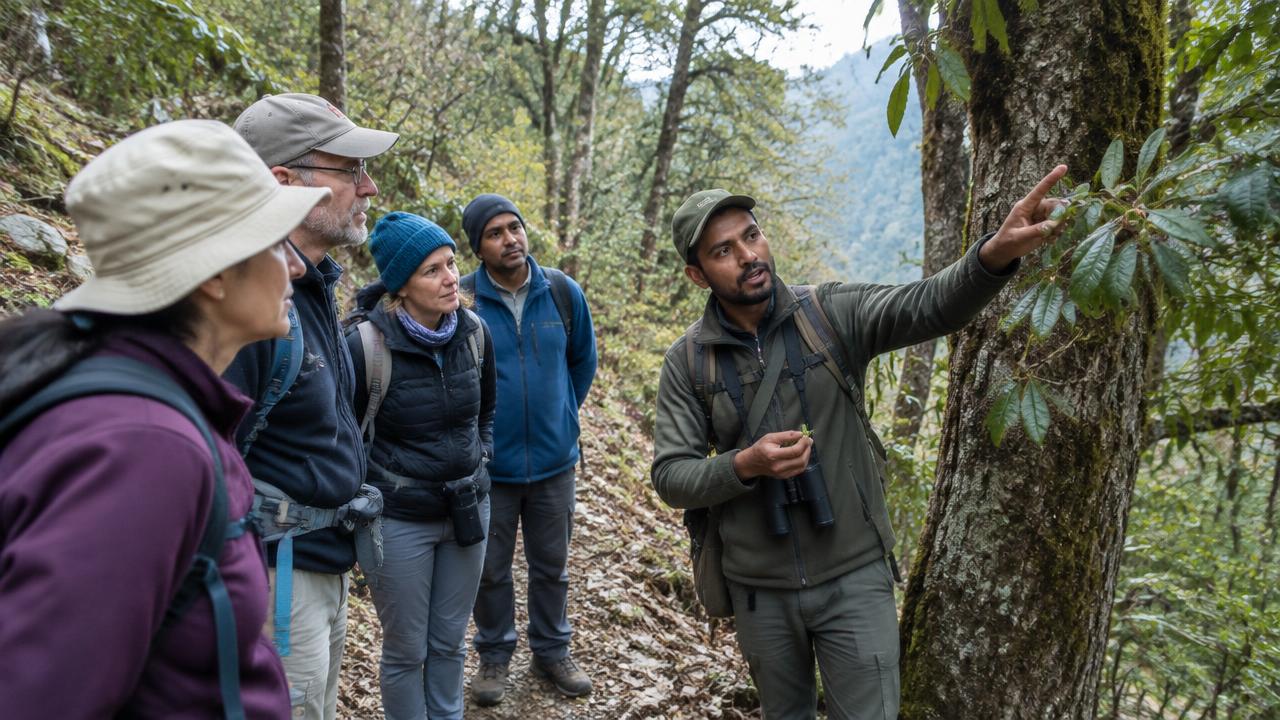
The sustainability policy requires that guests are guided by certified and skilled guides, usually local, and that staff undergo periodic training that includes assessment of environmental practices [B2]. The organization reports training Pangot youth as bird guides and, with the Ittu Sa Restaurant at Heritage Village near Jim Corbett, training local people as wildlife and bird watching guides [B1][B2]. With the non-profit Planeterra it reports training home stay owners, guides and other community tourism entrepreneurs [B1]. The sources do not describe the content, length or assessment of this training.
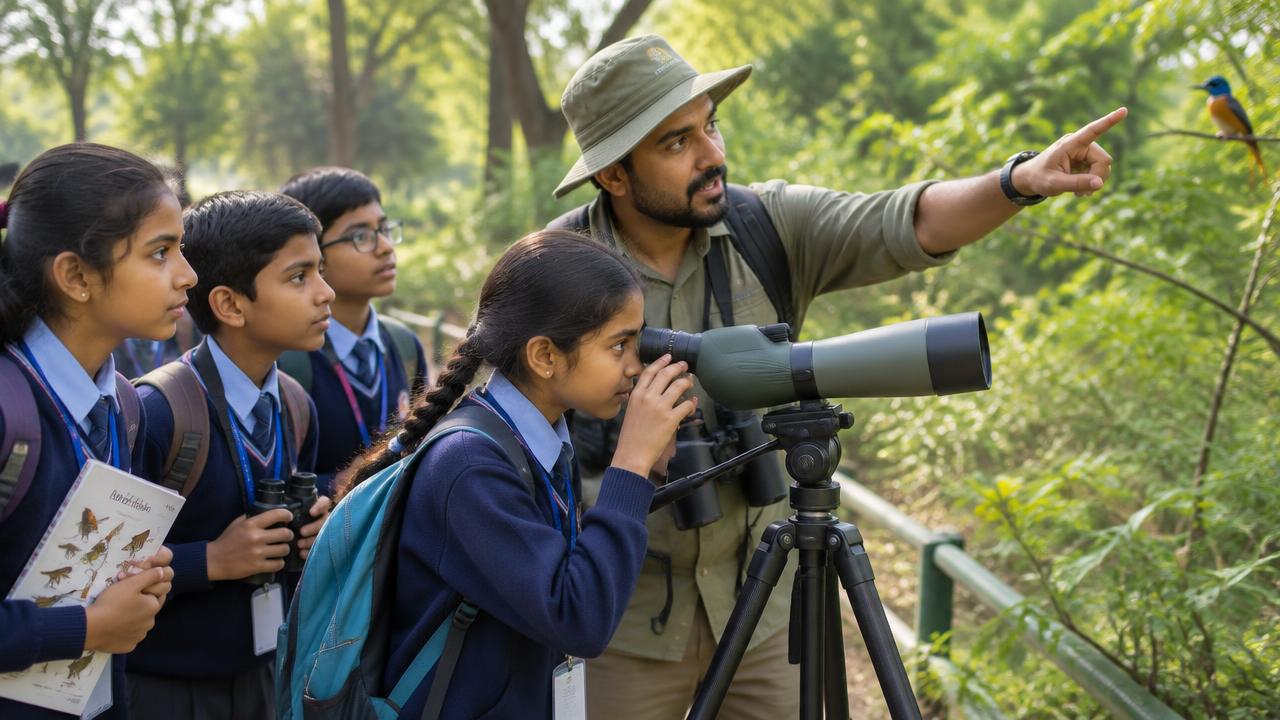
There are many schools involved. The Birders Store has donated two spotting scopes to the Nature Science Initiative via Asian Adventures with one going to Shining Star School in Corbett Tiger Reserve. Over 2500 students from over 70 schools have used these scopes for birding in the last year, while Nature Vidya have engaged 18 schools across 4 districts during the Great Backyard Bird Count [B1]. These figures are self reported. An independent report in 2024 states that around 50 students from an Eco club led by the Nature Science Initiative spotted a rare instance of a greater scaup at the Haripura wetland during the Great Backyard Bird Count [C7]. Asian Adventures is not mentioned showing the variety of what can be achieved by our partner network. The preliminary numbers for the Great Backyard Bird Count in India for 2026 show there were 1,092 species sighted, 64,992 checklists and 7,336 observers [C8].
3.5 Sustainable tourism economics and community partnerships
Earth Walks pay their guides Rs.500 per guided walk [B4]. This provides a small but regular source of income to local people based on volume. The organization encourages home stays rather than building new resorts as this will maintain the existing greenery [B1]. Preference is given to accommodation with GSTC, Travelife or similar certifications or working towards them [B2]. They have also supported e-fencing around Kaziranga, funded the Oriental Bird Club, provided funding for training by Bagh Foundation in Nandaur Tiger Reserve and started wildlife protection initiatives within Corbett [B1]. There was no information found in public sources regarding how much income local people received, how much was spent locally or how much was allocated to conservation projects.
Table 1. Conservation-awareness channels of Asian Adventures and the strength of public evidence
- Channel — What is publicly documented — Awareness role — Evidence status
- Birding tours — Species-specific itineraries; field waste rules; WaderQuest monitoring by guides; 1% conservation contribution on partner tours [B1][B5][B7] — In-field interpretation; guest participation — Itineraries public; monitoring self-reported, no outputs
- Jungle Lore Birding Lodge, Pangot — Five cottages; bird library; Zero Waste Pangot Drive; garbage–wildlife study; youth guide training [B1][C1] — Waste and plastic awareness; local guides — Self-reported; independent reports confirm village programme but do not name the lodge [C5][C6]
- Gir Birding Lodge, Sasan Gir — Pangolin Project: awareness among nearby communities; work with officials [B1] — Species awareness near a protected area — Self-reported; no results
- Earth Walks — Two-hour guided walks in several cities with named naturalists; feedback session [B3][B4][B6] — Urban public awareness; guide networks — Independent event listings; no outcome data
- Guide training — Certified, usually local guides required; Pangot and Corbett-area training; Planeterra [B1][B2] — Local messengers — Policy public; training content not described
- School birdwatching — Over 2,500 students, 70+ schools; 18 schools in Great Backyard Bird Count [B1] — Youth engagement — Self-reported; period unspecified
04Practical Challenges and Opportunities
4.1 Carrying capacity and habitat disturbance
The awareness schemes allow visitors to visit the habitats they are wanting to conserve. With only 5 cottages available [C1], Jungle Lore has limited numbers on their trails. The group size on the trails can be large and disruptive to nesting and roosting birds within the public wetlands and urban parks used on the Earth Walks. There is general guidance provided within the public documents [B2] however there are no specific restrictions regarding group sizes, trail usage or seasonal restrictions. Best practice would be to set maximum group sizes, prohibit the use of call playing and baiting, avoid nesting areas during the breeding season and enforce the principle of ‘silent observation’ within Earth Walk listings [B6].
4.2 Reach, access and message quality
Free to Rs 650 and Rs 900 per head [B4][B6]. Children under 12 can go free if a parent pays [B4]. Most of the listings are in English so will not appeal to those outside an urban audience who do not speak English. Message quality depends on the guide, and the public record does not say who certifies guides or how they are reviewed [B2]. Messages built on a single appealing species, such as the pangolin, risk the weakness the imagery review identifies: attention without demonstrated behaviour change [C4].
4.3 Sustaining village-level change
The Pangot case demonstrates that whilst the local village scheme helps to sort and manage waste [C6], the lack of a recycling facility in the village [C1] means the scheme relies on a small number of individuals to keep it going. It also relies on tourists bringing less plastic. There are no records available after 2018 (publically available information between 2017-2018), so it is unknown if the changes have been sustained.
4.4 Measuring awareness and impact
Given the gap between awareness and action [C2][C3][C4] the reporting should reflect the actions taken. Asian Adventures has provided limited information on actions undertaken. There is no information on how many Earth Walks there were or how many people took part. Feedback was not published, nor were results from WaderQuest and the Pangot study. How many people were reached via the Pangolin Project was not given and there was no independent evaluation. Table 2 shows potential indicators.
Table 2. Proposed indicators for reporting conservation-awareness outcomes
- Domain — Indicator — What it would show
- Reach — Walks held per year by city; participants and repeat participants; schools and students engaged, with period stated; Pangolin Project sessions and people reached — Scale and depth of engagement
- Attitude and knowledge — Short before-and-after questions on species and threats; feedback-form results summarized — Whether the message is understood
- Action — Follow-up at 3 and 12 months: checklists submitted, groups joined, behaviour changes reported — Whether awareness leads to action [C3]
- Local outcomes — Pangot: plastic entering the village and waste diverted by year; Gir: pangolin sightings or poaching reports passed to authorities, with permission — Whether on-the-ground change follows
- Educators — Guides trained and certified; training hours; guide income per walk; guides active after one year — Capacity and local benefit [A3][A4]
- Footprint — Group-size limits and compliance; travel emissions per participant — Environmental cost of the programme [A3][A4]
4.5 Opportunities
Most gaps can be closed at low cost:
- Write an update blog about Pangot. This will provide evidence of a well known story by writing a short annual report about waste amounts, partners and what has changed since 2018.
- Implement an action for every message. Every Earth Walk and Pangolin Project session will have a specific action (e.g. checklist, waste commitment and reporting channel) for participants to complete. They can be tracked.
- Include a feedback section. Include a few general questions in every walk [B6]. Write an annual summary.
- Include information about what they are doing, how many hours they are completing, how they are being assessed and who is certifying them. Track how much money guides are making.
- Increase language options. Provide interpreters in Hindi and regional languages to reach a wider audience.
- Link to citizen science. Where participants record sightings, use a common method and feed results back, which gives awareness a lasting outlet.
05Conclusion
Asian Adventures operates a coherent set of awareness channels within ecotourism: guided birding tours with simple guest actions, lodges where waste and species issues are visible, a species-awareness project at Gir, school support and a city programme, Earth Walks, that takes the approach to ordinary neighbourhood. Measured against the UN Tourism and GSTC emphasis on interpretation, the CBD’s emphasis on public awareness and the Global Biodiversity Framework’s call for communication and education, the design is sound [A1][A3][A4][A7]. Measured against the research, which shows that awareness and action are only loosely linked [C2][C3][C4], the public record is incomplete: it shows who communicates and where, but not what changes afterwards.
06There are three steps that can be taken to bridge this gap. Firstly the organization should report annually on their outreach and impact. Secondly the messages can be matched to an action by programme designers and tested to see if this happens. Thirdly funders and conservation bodies can support those who report these outcomes. This shows that for Indian ecotourism to increase awareness of conservation there needs to be a change in the field.
07References
(A) Global policy and standard frameworks
[A1] UN Tourism. Ecotourism and Protected Areas. Accessed October 2026. https://www.untourism.int/ar/node/85
[A2] UNEP and World Tourism Organization (2005). Making Tourism More Sustainable: A Guide for Policy Makers. Definition as quoted in the UNESCO World Heritage Centre glossary, “Sustainable Tourism.” https://whc.unesco.org/fr/glossaire/376/
[A3] Global Sustainable Tourism Council. GSTC Destination Criteria (v2.0, 2019) and overview of GSTC Criteria sets. Accessed October 2026. https://gstcouncil.org/gstc-criteria/gstc-destination-criteria
[A4] Secretariat of the Convention on Biological Diversity (2004). Guidelines on Biodiversity and Tourism Development. Montreal. https://www.cbd.int/tourism/guidelines.shtml
[A5] The International Ecotourism Society (TIES). TIES Overview: What Is Ecotourism? (definition, 1990). https://ecotourism.org/ties-overview
[A6] Convention on Biological Diversity. Communication, Education and Public Awareness (CEPA). Accessed November 2026. https://www.cbd.int/cepa/
[A7] Convention on Biological Diversity. Kunming-Montreal Global Biodiversity Framework, Target 21: Ensure that Knowledge is Available and Accessible to Guide Biodiversity Action. https://www.cbd.int/gbf/targets/21
[A8] United Nations. Sustainable Development Goal Target 4.7, as reproduced on the Statistics Austria SDG indicators page. Accessed November 2026. https://www.statistik.at/en/services/tools/data-access/sdgs/goal-4-quality-education/target-47
(B) Organisational sources: Asian Adventures and Earth Walks
[B1] Asian Adventures. Tourism for Conservation – Conservation for Tourism (Conservation page). Accessed October 2026. https://www.asianadventures.net/conservation
[B2] Asian Adventures. Sustainability Policy. Accessed October 2026. https://www.asianadventures.net/sustainability-policy
[B3] Asian Adventures. About Earth Walks. Accessed October 2026. https://www.asianadventures.net/about-earth-walks
[B4] Asian Adventures. Earth Walks (programme presentation, PDF). https://asianadventures.net/sites/default/files/Earth-Walks.pdf
[B5] Asian Adventures. Home page, including office address, tours and eco-tourism statements. Accessed October 2026. https://www.asianadventures.net
[B6] Earth Walk event listings published with Asian Adventures as host: “Wing Beats of Najafgarh” (28 Dec 2025); “Birds, Wetlands and Beyond” (Chandu Budhera, 9 Aug 2026); “Echoes of Yamuna” (Asita East, 16 Aug 2026); “Wings & Wilderness” (Ekana Wetland, 20 Sep 2026); “Silent Flyers: Sarus Trails” (Dhanauri, 31 May 2026); “Flora & Fauna of Gujarat University Campus” (21 Sep 2025). https://happeningnext.com/event/wing-beats-of-najafgarh-eid1ar6igwshj
https://happeningnext.com/event/birds-wetlands-and-beyond-eid1ar58672sj https://happeningnext.com/event/echoes-of-yamuna-eid1ar7nj8l4p
https://happeningnext.com/event/wings-andamp-wilderness-eid1ar5t5gqht
https://allevents.in/sirsa/silent-flyers-sarus-trails-earth-walks-at-dhanauri-tickets/80002975214891
https://allevents.in/ahmedabad/flora-and-fauna-of-gujarat-university-campus/80002825829206
[B7] Bubo Birding. About Bubo Birding (partner brand; logistics by Asian Adventures; 1% conservation contribution). https://bubobirding.com/about
[B8] Bubo Birding. Himalayan Birding Tour: Pangot, Sattal, Corbett, Trip Report, November 2020. https://bubobirding.com/himalayan-birding-tour-pangot-sattal-corbett-trip-report-november-2020/
[B9] Bubo Birding. Gir National Park, Gujarat (tour page; booking handled by Asian Adventures). https://bubobirding.com/tour/gir-national-park-gujarat/
(C) Supporting independent sources
[C1] Responsible Tourism India. Jungle Lore Birding Lodge. https://www.responsibletourismindia.com/stay/jungle-lore-birding-lodge/474
[C2] Kollmuss, A. and Agyeman, J. (2002). Mind the gap: why do people act environmentally and what are the barriers to pro-environmental behavior? Environmental Education Research 8(3), 239–260. doi:10.1080/13504620220145401. https://doi.org/10.1080/13504620220145401
[C3] Soga, M. and Gaston, K. J. (2023). Do people who experience more nature act more to protect it? A meta-analysis. Biological Conservation 289, 110417. doi:10.1016/j.biocon.2023.110417. https://ore.exeter.ac.uk/repository/handle/10871/134980
[C4] Thomas-Walters, L., McNulty, C. and Veríssimo, D. (2019). A scoping review into the impact of animal imagery on pro-environmental outcomes. Ambio 49(6), 1135–1145. doi:10.1007/s13280-019-01271-1. https://doi.org/10.1007/s13280-019-01271-1
[C5] UNEP (24 May 2018). In India, a paradise for birds goes plastic free (video, Nature Action). https://www.unep.org/news-and-stories/video/india-paradise-birds-goes-plastic-free
[C6] IBNS (5 June 2023). World Environment Day: slowly but steadily, Indian tourist destinations are working to combat the rise of plastic pollution. Northeast Herald. https://neherald.com/health/world-environment-day-slowly-but-steadily-indian-tourist-destinations-are-working-to-combat-the-rise-of-plastic-pollution
[C7] Village Square (26 March 2024). Yay! We spotted the rare greater scaup duck. https://villagesquare.in/uttarakhand-school-students-spot-rare-greater-scaup-duck/
[C8] Bird Count India. Great Backyard Bird Count, India. Preliminary 2026 results and protocol. https://birdcount.in/event/gbbc/