Abstract
Nature education is now seen as an important part of increasing environmental awareness and sustainable practices. Countries such as India have a high level of biodiversity but lack any understanding of how this biodiversity works. Outdoor learning provides people with the necessary knowledge. This article discusses an organization called Asian Adventures that was set up in 1994. They provide bird watching tours, nature lodges and Earth Walks. These follow the guidelines of the Global Sustainable Tourism Council (GSTC) and the Education for Sustainable Development initiative by UNESCO. The nature guides are trained naturalists with knowledge of the local area and wildlife. The walks are targeted at people who do not have any previous experience with nature. The tours have been assessed but most of the data comes from self assessment. There is no measure of what they have learn so the educational value can only be found by doing a planned assessment of their knowledge.
01Introduction: Understanding Nature Education
The basis of nature education is that if people understand something they are more likely to protect it. It is believed that learning through first-hand experience of the natural world will create the highest level of understanding. Environmental education has been developed since the 1970s and understands the importance of providing learners with knowledge, values and skills as well as understanding how their experiences can influence behaviour (Hungerford and Volk 1990). This type of education has now moved beyond the classroom and can be applied to many different environments such as parks, forests, wetlands and gardens. Learners can observe organisms and learn about the ecosystems they are part of.
Two international frameworks can be referenced. UNESCO's Education for Sustainable Development (ESD) aims to provide learners with the knowledge, skills, values and empowerment needed to overcome sustainability issues. This links with Sustainable Development Goal 4.7 which aims to provide learners with the knowledge and skills needed to promote Sustainable Development. This includes education on sustainable living, as well as understanding the importance of cultural diversity and how culture contributes to Sustainable Development. Article 13 of the Convention on Biological Diversity (CBD) states that countries should encourage and promote an understanding of the importance of conserving biodiversity and support education and awareness raising activities.
The tourism sector offers a unique setting for achieving these aims. The Global Sustainable Tourism Council (GSTC) has established Destination Criteria that include criteria such as C5, which states that the interpretation of the site is to be provided to the tourists visiting the destination.Interpretation of this kind is a form of nature education, and it is delivered during the activities that visitors have chosen for leisure. This makes tour operators and lodges significant, if under recognized, providers of environmental learning.
India presents both a need and an opportunity for nature education. The country is home to over a thousand different species of birds, as well as numerous different types of habitats. However, many of the urban residents of India do not have access to these habitats. Therefore, the delivery of nature education to these people is of particular importance. This article will use the frameworks established above to evaluate the delivery of nature education by the Indian company Asian Adventures.
02The Role of Nature Education in Conservation
Nature education is a means of contributing to conservation efforts through various mechanisms that operate within the realms of knowledge, attitude, behavior and community. Each of these subsections will discuss the different ways in which nature education can contribute to conservation efforts and under what conditions each of those contributions are made.
2.1 Biodiversity Awareness and Education
Awareness is the entry point.These skills allow people to appreciate the ecosystems in which these species exist and to recognize the changes that happen within those ecosystems.Learning about these skills can be done quite effectively through bird watching. There are many different types of birds that can be observed. Other animals such as insects, dragonflies, butterflies and plants can also provide opportunities for people to learn these skills. This can then be linked to other ecological concepts such as food webs, migration and wetland functions.
2.2 Local Community Engagement
If nature education builds stronger connections between local residents and their natural environments, it will be a sustained practice. Equipping local residents as naturalists means building a skilled workforce, and giving the community ownership of the nature education provided to visitors. The GSTC Destination Criteria highlight the importance of benefiting the host community and nature education can easily fit this if local residents are providing the education. Local people can also get involved with nature education including local history and land uses.
2.3 Responsible Interaction and Learning Protocols
Learning and observation can cause disturbance. Birds can get stressed by groups of people crowding around their roosts, playing noises and straying off trail. As responsible nature educators we should have guidelines to keep groups small, keep a good distance, keep noise down and behaviour appropriate. By having guides to explain why we shouldn’t approach the birds we are giving a reason for them to follow the rules, this will help create long term habits. The guidelines should also be specific to the location you are in, especially when observing wetland birds during breeding and roosting periods. Documentation of such protocols for the operator examined here was limited in the sources reviewed, which is discussed further in Section 4.
2.4 Long-Term Behavioral Outcomes
Ultimately, a successful nature education activity would result in behavior change. This could include individuals continuing to observe wildlife, supporting conservation organizations, reducing waste within wetland areas and promoting local green areas. However, behavior change is rarely measured within tourism and community education programs. Behavior change can be measured through post surveys, longitudinal and behaviour based data such as citizen science. If this is not measured, claims of behavior change will be speculation. Whilst the environmental pillar of the GSTC Criteria highlights biodiversity and landscape conservation, and the wider ESD framework focuses on learner action, there is no mention of how to measure these outcomes.
03How Asian Adventures Delivers Nature Education in India
Asian Adventures was founded in 1994. It is run by Mohit Aggarwal who is trying to promote environmental preservation and responsible tourism by offering a variety of adventures and trips throughout the Indian sub continent. The organization has registered services which include wildlife and bird watching holidays, cultural holidays, Eco-lodges and day nature walks. This will be discussed below and will show how different aspects can provide nature education. Information obtained from the organization or its partners will be noted as an assumption.
3.1 Bird watching and Low-Impact Tours as Learning Experiences
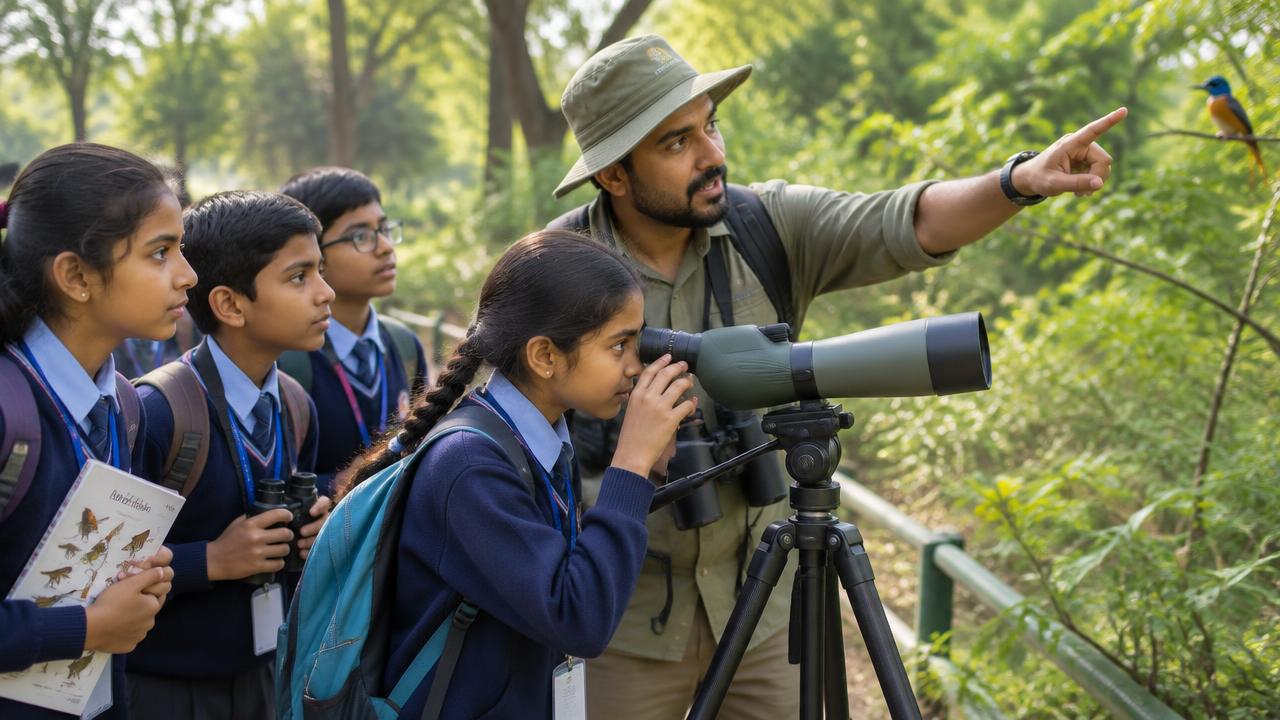
Bird watching tours are the company’s core product and its most sustained educational activity. Tours can be bespoke or structured. Usually they take the form of a guided walk where you can observe and learn the ID. The structure is progressive, starting with the most common species and then moving on to identifying calls, behaviours and habitats over the course of a few days. Reports of trips by the company show how this is done. Most of the time you will have a guide showing you around and telling you about what you are seeing.The company’s partnership with Bubo Birding also shows how learning and conservation finance can be linked. According to Bubo Birding’s account, 1% of the tour cost goes directly to a conservation fund supporting local projects, including training programmes for the Bagh Foundation at Nandaur Wildlife Sanctuary and Tiger Reserve. This is a fairly small funding source that has not been externally audited. However, there is a clear connection here that ties directly back to the educational experience with a clear conservation goal.
3.2 Eco-Lodges as Settings for Extended Learning
Lodges extend the learning window beyond a single day’s outing.Visitors can enjoy bird watching from the ground, guided multi-day walks and also learn about the local ecology at dusk and dawn.
Jungle Lore Birding Lodge, Pangot. Jungle Lore is located on a forested hill slope in Pangot, near Nainital in Uttarakhand, and is set amidst oak trees. Its educational offer goes beyond birding. A questionnaire completed for an international birding publication lists nature walks, village walks, picnics, butterfly and moth exploration activities, bonfires and barbecue nights, stargazing activities, and similar programmes, which broaden the subjects available to non-specialist guests. Reviewers have commented on the guides, with one describing them as knowledgeable, and a reviewer reported that visitors could see more than forty species from the lodge premises. The lodge’s sources differ on its size and founding date. This needs to be resolved before publishing. The year of establishment is given as 1997 in the questionnaire but it says in the magazine article (2021) that the lodge was over 20 years old. The number of cottages varies between 4-5.
Gir Birding Lodge, Sasan Gir. The lodge describes itself as the first bird watching lodge in Gujarat and occupies 22 acres of orchards and generously canopied trees. Its setting near Gir National Park offers a rare combination of learning opportunities: bird watching in the lodge grounds and nearby forest, and guided safaris conducted by park guides in open vehicles. The lodge’s material states that Gir is the only place in India that has the last remaining population of wild Asiatic Lions making this an important area to understand predator-prey relationships, habitat management and conservation history. However, the information provided in the sources does not give much detail on what is being interpreted.
3.3 Earth Walks: Nature Education for Urban Citizens
The most unique element of the education offered by the program are the Earth Walks. This targets individuals who wouldn’t normally engage with nature due to the fact that they live in an urban area. The walks are short and lead by a guide. They are done in easily accessible areas like parks, wetlands and flood plains of rivers. The walk aims to educate the participants about their local ecosystems.
The walks are held across several cities. Earth Walks have been organized in places like Asita East DDA Park, Laxmi Nagar, Delhi to raise awareness on exploring wetlands, flood plains of Yamuna and biodiversity of the area. An awareness session was also held in Ekana Wetland, Lucknow to spread awareness on wetland ecosystems and their biodiversity. In Dhanauri Wetlands, Uttar Pradesh, Earth Walk was organized with a focus on Sarus Crane habitat. An Earth Walk was conducted at Haiderpur wetland (part of Hastinapur Wildlife Sanctuary) in 2022 which was documented in our company trip report. An Earth Walk was organized in Kolkata to highlight the importance of wetlands, local communities and urban areas. In Najafgarh, an expert guided Earth Walk was organized for winter birds and wetland biodiversity.
The educational structure is consistent across walks. Typically, a programme will include a brief introduction to the site and its ecology, followed by a bird watching and habitat survey period. Insect and organism identification will occur, and time will be spent reviewing the session. One programme in Delhi will specifically include some learning around why urban wetlands and riverine habitats are important for biodiversity conservation. Binoculars and comfortable shoes are recommended for this walk.The walks also take account of the setting in which learning occurs. The Delhi terms of participation require a manner that is respectful to fellow participants and the local community, and they set a strict no alcohol and substance policy. These rules protect the group experience and the site, which matters for wetland education because noise and litter affect waterbirds.
Urban wetland education has particular significance because these sites are under pressure.The ‘East Kolkata Wetlands’ face threat of urbanization and illegal landfill (2025 Travel Magazine). However, walks that allow citizens to get close to these wetlands can help to increase public knowledge about these areas and therefore gain support for their conservation. The link between participation and later civic action has not been studied for these walks, however, and it remains an assumption of the programme’s design.
3.4 Educational Interpretation Through Trained Naturalists
The quality of interpretation will depend on the knowledge, teaching ability and communication skills of those guiding the learners. The programme also relies on trained naturalists and walking guides. The event listings include a number of guides. As seen in a 2019 trip report ‘Your guide, the Asian Adventures Naturalist, will give you a briefing about the day’ (trip report 2019) showing there is a formal role for naturalists.
The questionnaire feedback from the Pangot lodge states that by training naturalists and instilling the bird watching spirit in them Jungle Lore have made ecotourism an essential part of everyday life for the community. This describes a plausible pathway in which local people acquire ecological knowledge and teaching skill, and the same knowledge then enriches visitors’ learning. There was no mention of how many naturalists were trained and retained or how effectively they interpreted nature.
Interpretation also reaches audiences through published trip reports, event descriptions, and walk summaries. These materials extend the programme’s educational reach beyond participants, although their content is promotional in character and should be read with that in mind.
3.5 Economics of Nature Education and Community Partnerships
The programmed need to be economically viable. In this case Naturalists are funded through tourism, lodges and an aspect of conservation within the price of tours. Some Earth Walks are offered free, whereas others are paid (Najafgarh had one listing for INR 650 per person). This means there is a wide accessibility for some whilst keeping the programme viable. There was no mention of any data collected including sociology-economic background of visitors or how many people visited nature for the first time. Partnerships with the community can also be seen throughout.
Local staff and guides are essential to lodge operations, the naturalist programme depends on local expertise, and Earth Walks depend on the cooperation of local site managers and communities. Formal agreements for these relationships were not documented in the public material reviewed. There was no mention of how many naturalists were trained and retained or how effectively they interpreted nature. To see the programmed impact on the community economically we would need to know how many people were employed, what they were paid and what percentage of revenue was kept local.
04Practical Challenges and Opportunities
4.1 Carrying Capacity in Learning Settings
Carrying capacity is a key restriction within nature education. Large groups, high visitation rates, and disruptive/ noisy learning can cause disturbance to local wildlife, damage to flora and decrease in quality of the experience. Earth Walks take groups of people to sites which may contain breeding/nesting/wintering bird species. The publicly available information does not specify any limits on how many people can attend, how often they can attend, or what the carrying capacity is for each site. This could be improved by defining and publishing these limits. A practical solution would be to define a maximum number of attendees per site, and maximum visitation rate based on monitoring data. Visits could also be paused during sensitive times.
4.2 Habitat Disturbance Mitigation
There are standard mitigation strategies for disturbance. This includes walking on established routes, keeping groups small near sensitive areas, not playing any bird calls, restricting observations during breeding seasons and ceasing observations if signs of stress are seen in the birds. Whilst the company have guidelines for participating in walks, guidelines specific to each site are required. Training leaders to identify signs of disturbance such as alarm calls, ceasing to feed or moving away would be an effective strategy. Guidelines could also be made public so that partners such as site managers can see them and agree with them.
4.3 Learning Quality and Interpretive Standards
Consistency is a common issue in nature education. The quality of learning depends on the knowledge and teaching skill of individual leaders, and programmed that expand quickly across many cities risk variable interpretation. Standardized learning outcomes for each walk type, shared species and habitat content, and periodic peer review of guides would help. The GSTC Destination Criteria’s requirement for site interpretation provides a benchmark, and aligning Earth Walk content against it would make the programme’s educational standards more transparent.
4.4 Measuring Educational and Conservation Impact
The most significant challenge is measurement. The company’s public claims are expressed largely as inputs and outputs: walks held, cities served, naturalists trained, and the percentage of tour costs allocated to conservation. This highlights that these are measures of engagement only. To demonstrate learning, changes in behaviour, or conservation contributions, pre and post data should be gathered to show knowledge and attitude changes. Behavioral change can be measured by gathering follow up data. Conservation impacts can be measured using metrics at a site level for example bird population trends and habitat quality.
Citizen science can be utilized here. If structured bird data were regularly collected from Earth Walks and lodge based activities, participants would be contributing to long-term biodiversity datasets. This would also provide them with an opportunity to practise their observation and identification skills. This would translate learning engagement into evidence and provide ongoing involvement for the participants. However, the sources reviewed did not indicate that this was done systematically, meaning there is an obvious opportunity here.
05Conclusion: Toward Accountable Nature Education
As with many good models of nature education the Asian Adventures program utilities several key elements. Firstly, the bird watching tours help develop identification and ecological knowledge. The lodges also provide opportunities to learn and offer a variety of activities including walking around villages and moth surveys to cater for a variety of visitors. Its Earth Walks bring nature education to urban citizens who rarely encounter wetlands, and they frame those wetlands as public assets under pressure. Its philosophy, “Tourism for Conservation, Conservation for Tourism,” places education within a conservation purpose, and its stated commitment to local naturalist training links learning to livelihood.
The model has not yet shown any learning outcomes or conservation benefits, there is limited evidence. Most of the evidence comes from organizational documents, partners, and lodges. There is also some documentation about events. There is no mention of learning outcomes, behaviour changes and conservation results. This does not mean the programme is not strong but limits how much we know the programme contributes to learning.
Improvements can be made to this programme by setting clear learning outcomes for each type of walk and measuring these pre and post. Disturbance guidelines and carrying capacity thresholds should be set for each site and managers should be consulted. Trained guides should be used with a standardized interpretation training. Content within the training should fit with established standards such as GSTC Destination Criteria. A structured bird survey should be introduced and results should be reported. Asian Adventures is well positioned as a leader in urban wetland education. If learning outcomes and actions are measured and reported, the model can be a practical example for nature education in India.
06References
A. Global Policy and Standard Frameworks
- Convention on Biological Diversity (1992). Convention on Biological Diversity, Article 13: Public Education and Awareness. https://www.cbd.int/convention/articles/?a=cbd-13
- Convention on Biological Diversity (2022). Kunming-Montreal Global Biodiversity Framework, Decision 15/4. https://www.cbd.int/gbf
- Global Sustainable Tourism Council (GSTC). GSTC Criteria, Destination Criteria, Section C: Cultural Impacts, Criterion C5 (Site Interpretation). https://www.gstcouncil.org/gstc-criteria/
- Global Sustainable Tourism Council (GSTC). GSTC Standards Overview, including the Destination, Tour Operator, and Attraction Standards. https://www.gstc.org/en/gstc-certification/gstc-criteria/sustainable-tourism-gstc-criteria.html
- UNESCO (2020). Education for Sustainable Development: A Roadmap. Paris: UNESCO. https://www.unesco.org/en/education-sustainable-development
- United Nations (2015). Transforming Our World: The 2030 Agenda for Sustainable Development, Sustainable Development Goal 4, Target 4.7. New York: United Nations.
B. Academic and Foundational Sources
- Hungerford, H. R., and Volk, T. L. (1990). Changing learner behavior through environmental education. The Journal of Environmental Education 21(3): 8–21.
- The Ecotourism Society (2015). Definition of Ecotourism. https://ecotourism.org
C. Organizational Sources
- Asian Adventures. Organizational profile, IATO Members Directory. https://iato.in/members/view/2539
- Bubo Birding. “About Bubo Birding,” including the description of Asian Adventures’ conservation allocation. https://bubobirding.com/about
- Jungle Lore Birding Lodge. Lodge information and tariff sheet, Pangot, Uttarakhand. https://junglelorebirdinglodge.com/
- Jungle Lore Birding Lodge (n.d.). Questionnaire response for the 10,000 Birds lodge directory. https://www.10000birds.com/birding-lodges-of-the-world-jungle-lore-birding-lodge-india.htm
- Gir Birding Lodge (n.d.). Programme and property information, Sasan Gir, District Junagadh, Gujarat.
- Asian Adventures (2023). “Earth Walks at Haiderpur Wetland,” trip report. https://asianadventures6.blogspot.com/2023/01/earth-walks-at-haiderpur-wetland.html
- Asian Adventures (n.d.). Delhi Earth Walks terms and conditions. Published document.
- Asian Adventures. Earth Walk and nature walk event listings, including “Echoes of Yamuna” (Delhi), “Wings & Wilderness” (Ekana Wetland, Lucknow), “Silent Flyers: Sarus Trails” (Dhanauri Wetlands), “East Kolkata Wetlands: History & Biodiversity,” and “Wing Beats of Najafgarh.” Event platforms: HappeningNext and AllEvents.